MANAGE YOUR RISK
Scott says figuring out how to manage risk is “the most important question of all,” and it’s what everyone should focus on as they start their investing journey.
Risk tolerance the level of risk and potential loss someone is comfortable with — varies significantly. A person’s age, goals, and investing timeline- when they plan to withdraw their money— affect their risk tolerance. Generally, investors who are older and closer to retirement will want to take a less risky strategy because they’re operating on a shorter timeline and will have less time to recover any potential losses. Investors with a longer timeline young people saving for retirement, for example-can afford to make more risky investments because they have more time to recover.
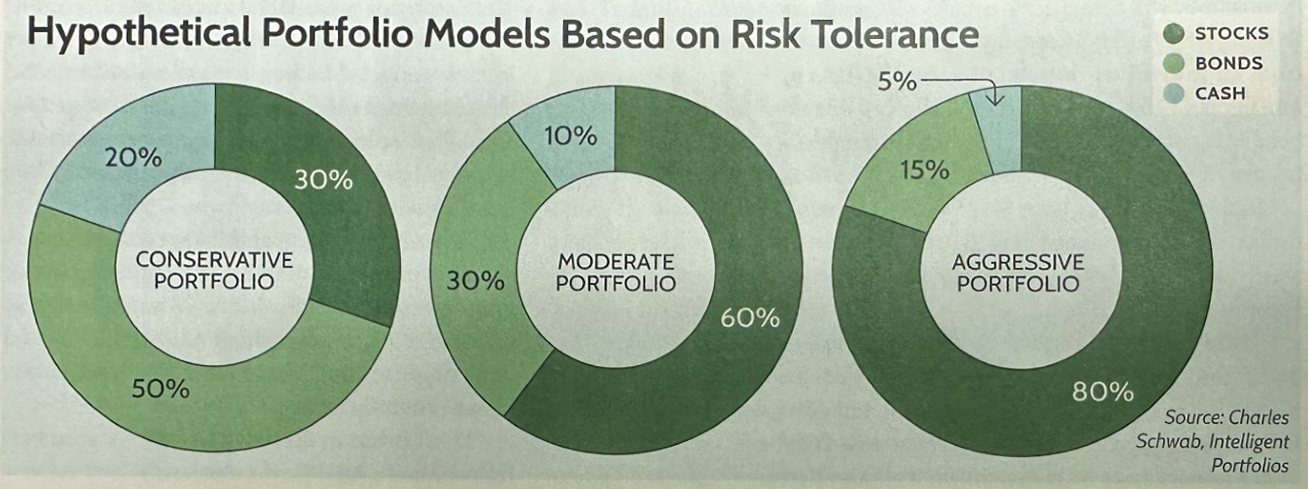
Investors fall into three broad categories of risk: aggressive, moderate, and conservative. Aggressive investors are the most comfortable with risks, willing to take big ones in the hopes of seeing big rewards, even if it means weathering the steep highs and lows of market fluctuations. Moderate investors are less comfortable with risk but are willing to tolerate some losses while pursuing moderate gains. Conservative investors are the least risk-tolerant, seeking out investments that are more stable even though they are likely to yield lower results.
When figuring out where they stand on the risk-tolerance scale, Scott advises people to ask themselves, “What is it that I’m risking?”
When figuring out where they stand on the risk-tolerance scale, Scott advises people to ask themselves, “What is it that I’m risking?”
“If I invest this money, and it drops 45%, what’s the impact to my lifestyle going to be?” Scott says. “And if the impact to your lifestyle is going to be severe, then that means you’ve got to find something less risky.”
However, being too risk-averse can lead to missed financial opportunities.
“Over time, not being invested is exponentially harmful because you miss out on so much compounding,” says Dr. Preston Cherry, president of Concurrent Financial Planning and director of the Charles Schwab Foundation Center for Financial Wellness at the University of Wisconsin, Green Bay, who’s also a member of the Investopedia Advisor Council. He encourages people to examine why they’re risk-averse, and he challenges that aversion with education.
“Your risk-averseness may keep you from achieving your goals,” Cherry says. “How would you feel if your life and money goals came up short because of not investing over time?”
Hypothetical Portfolio Models Based on Risk Tolerance.